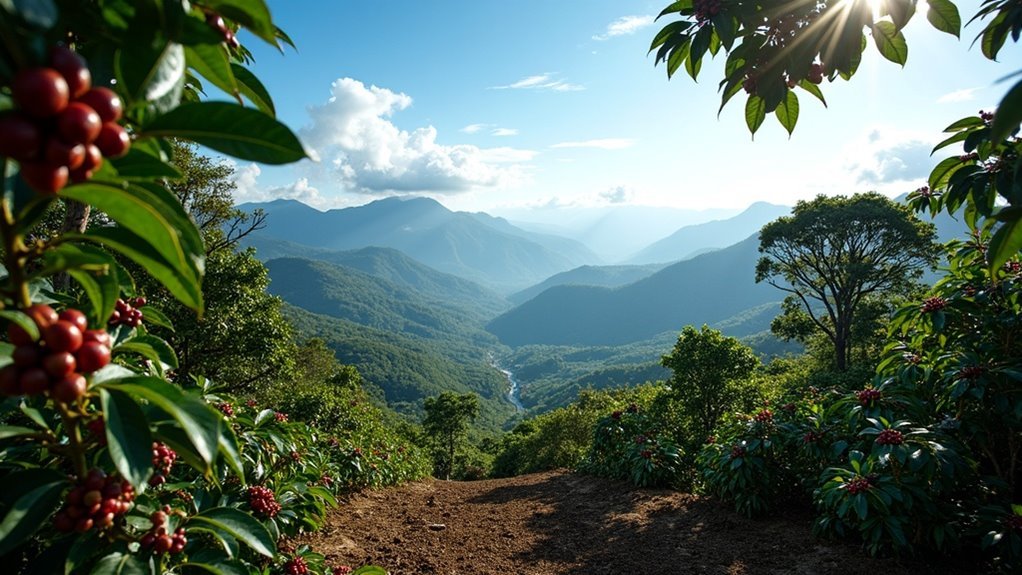
Blue Mountain varietal coffee comes exclusively from Jamaica’s Blue Mountain region and is highly esteemed for its exceptional quality. Grown at high elevations of 3,000 to 6,000 feet, this coffee features Arabica Typica beans, renowned for their smooth texture and mild, balanced flavor, complemented by chocolatey notes and virtually no bitterness. The coffee undergoes rigorous regulation by the Jamaica Agricultural Commodities Regulatory Authority, ensuring that only the finest beans are handpicked for quality assurance. To learn more about its unique growing conditions and processing methods, continue exploring this website dedicated to coffee.
Key Takeaways
- Blue Mountain varietal is a premium coffee grown exclusively in Jamaica’s Blue Mountain region, primarily consisting of Arabica Typica beans.
- It is cultivated at high elevations between 3,000 and 6,000 feet, which enhances its density and flavor richness.
- This coffee is renowned for its smooth, mild taste with chocolatey undertones and virtually no bitterness, making it a favorite among coffee enthusiasts.
- Stringent regulations by the Jamaica Agricultural Commodities Regulatory Authority (JACRA) ensure the authenticity and quality of Blue Mountain coffee.
- The certification process includes thorough inspections and handpicking of ripe cherries, safeguarding the coffee’s exceptional quality and helping to prevent counterfeiting.
Defining Blue Mountain Varietal
When you explore the world of specialty coffee, you’ll quickly discover that the Blue Mountain varietal stands out due to its unique origin and distinctive characteristics.
Grown exclusively in Jamaica’s Blue Mountain region, this high-quality coffee consists primarily of Arabica Typica beans cultivated at elevations between 3,000 and 6,000 feet. These unique growing conditions contribute to its exceptional taste profile.
Strict regulations by the Jamaica Agricultural Commodities Regulatory Authority ensure authenticity, as only fully ripe cherries are handpicked for processing.
The result is a smooth, mild coffee with balanced sweetness and subtle chocolatey notes, making Blue Mountain a remarkable choice in the coffee landscape.
Unique Flavor Profile and Characteristics
The unique flavor profile of Blue Mountain coffee captivates enthusiasts and casual drinkers alike, thanks to its silky smooth texture and well-balanced taste.
These coffee beans exhibit a mild taste with chocolatey undertones and virtually no bitterness, making them distinctly pleasant. Influenced by specific growing conditions in Jamaica’s Blue Mountains, the washed coffee processing highlights delicate flavors and aromas.
Expect a sweet-toned aroma, delicate floral notes, and a mint-like finish that becomes more pronounced as the cup cools. This remarkable flavor profile elevates Blue Mountain coffee, making it a prized treasure among coffee lovers worldwide.
Growing Conditions and Climate Influence
While many factors influence the quality of coffee, the unique growing conditions and climate of Jamaica’s Blue Mountain region play a pivotal role in shaping the exceptional characteristics of Blue Mountain coffee.
Cultivated at altitudes between 3,000 to 6,000 feet, the beans develop density and richness due to their slower maturation process. The region’s micro-climate, characterized by misty cloud cover and regular rainfall—averaging 2,250 mm annually—ensures optimal moisture content for healthy coffee cherries.
Consistent temperatures ranging from 16 to 24 degrees Celsius create ideal conditions for growth, while the steep slopes contribute to a distinct flavor profile, making the Blue Mountain variety truly exceptional.
Processing Methods for Blue Mountain Coffee
When it comes to processing Blue Mountain coffee, the emphasis on handpicking ripe cherries ensures that only the finest beans are selected.
An essential step in this process is float testing, which distinguishes high-quality cherries from those that are under ripe.
This meticulous approach, combined with wet processing techniques, establishes the foundation for the coffee’s renowned smooth and mild flavor profile.
Handpicking Ripe Cherries
Handpicking ripe cherries is crucial for ensuring the exceptional quality of Blue Mountain coffee. This meticulous and labor-intensive process involves skilled pickers who carefully evaluate each cherry, selecting only those that are at peak ripeness.
The steep slopes where these cherries grow add to the challenge, as the ripeness of each cherry has a direct impact on the quality of the final product. Once handpicked, the cherries undergo a pulping process to preserve their freshness and prevent spoilage.
After pulping, the beans are thoroughly inspected to remove any defects. By discarding unripe or damaged cherries, this careful selection process guarantees that only the highest quality beans are processed, ultimately enhancing the esteemed reputation of Blue Mountain coffee.
Float Testing Process
Float testing is a crucial step in ensuring the quality of coffee, particularly Blue Mountain coffee, where only the finest cherries make the cut.
During the float testing process, freshly harvested coffee cherries are placed in water; those that sink are considered high-quality, while unripe or damaged ones float and are discarded.
This meticulous selection process upholds the exceptional standards of Jamaican Blue Mountain Coffee, preserving its unique flavor profile.
Typically conducted at producer-processor buying stations, float testing helps eliminate defective cherries before pulping, ensuring that only the best cherries contribute to this prized coffee variety.
Wet Processing Techniques
After the careful selection process of float testing, the next step in producing high-quality Blue Mountain coffee is the wet processing technique.
This begins with selective handpicking of fully ripe cherries, ensuring only the finest fruit is utilized. Immediately after harvesting, the cherries undergo a pulping process, typically using aqua pulpers to maintain freshness, while traditional fermentation methods are seldom applied.
Following pulping, the beans are meticulously inspected to eliminate defects, guaranteeing only high-quality beans advance to drying.
This washed processing method greatly enhances the coffee’s flavor profile, resulting in the renowned smoothness and lack of bitterness characteristic of Blue Mountain coffee.
Authenticity and Certification of Blue Mountain Coffee
When it comes to Jamaican Blue Mountain Coffee, understanding the certification process is essential for ensuring authenticity.
The Jamaica Agricultural Commodities Regulatory Authority (JACRA) issues a certificate for each exported barrel, confirming its origin and quality.
Certification Process Overview
To ensure that only genuine Blue Mountain Coffee reaches consumers, the Jamaica Agricultural Commodities Regulatory Authority (JACRA) meticulously oversees the certification process. This guarantees that only coffee sourced from the designated Blue Mountain area can be labeled as Jamaica Blue Mountain Coffee. Each barrel is accompanied by a certificate of authenticity, verifying its origin and quality. Licensed estates prominently display the JACRA seal, adhering to stringent quality standards. JACRA monitors the entire coffee value chain, from nurseries to exporters, ensuring that only beans meeting rigorous criteria are marketed under this esteemed name.
| Certification Element | Description | Importance |
|---|---|---|
| Authenticity | Certificate from JACRA | Confirms origin and quality |
| Quality Standards | Compliance with JACRA rules | Maintains consumer trust |
| Licensed Estates | Registered producers | Guarantees legitimate marketing |
Counterfeit Products Awareness
As counterfeit products flood the market, understanding the authenticity and certification of Jamaica Blue Mountain Coffee is essential for coffee enthusiasts.
To confirm legitimacy, the Jamaican coffee industry mandates that every exported barrel is certified by the Jamaica Agricultural Commodities Regulatory Authority (JACRA). Only coffee grown within a strict 6,000ha area of the Blue Mountain range can be labeled as such.
Look for the JACRA seal from licensed companies to guarantee authenticity. Be cautious of low-priced offers, as they often indicate counterfeit products.
Additionally, innovative solutions like blockchain technology enhance verification and traceability, connecting coffee lovers directly to the coffee farms.
Market Demand and Global Significance
While the allure of Jamaican Blue Mountain Coffee captivates global coffee enthusiasts, its market demand continues to thrive despite rising competition from other specialty coffee regions.
Over 80% of production is exported to Japan, where aficionados cherish its exceptional quality and unique flavor profile. The coffee industry recognizes Blue Mountain as a premium specialty product, consistently scoring above 80 points on quality assessments.
However, improvements in quality from other countries have posed challenges to its esteemed status. The Jamaica Agricultural Commodities Regulatory Authority enforces stringent quality standards, ensuring authenticity and bolstering its significance in the global coffee market.
This commitment to quality sustains demand among discerning coffee drinkers, solidifying Blue Mountain’s luxurious reputation in the world of coffee.